
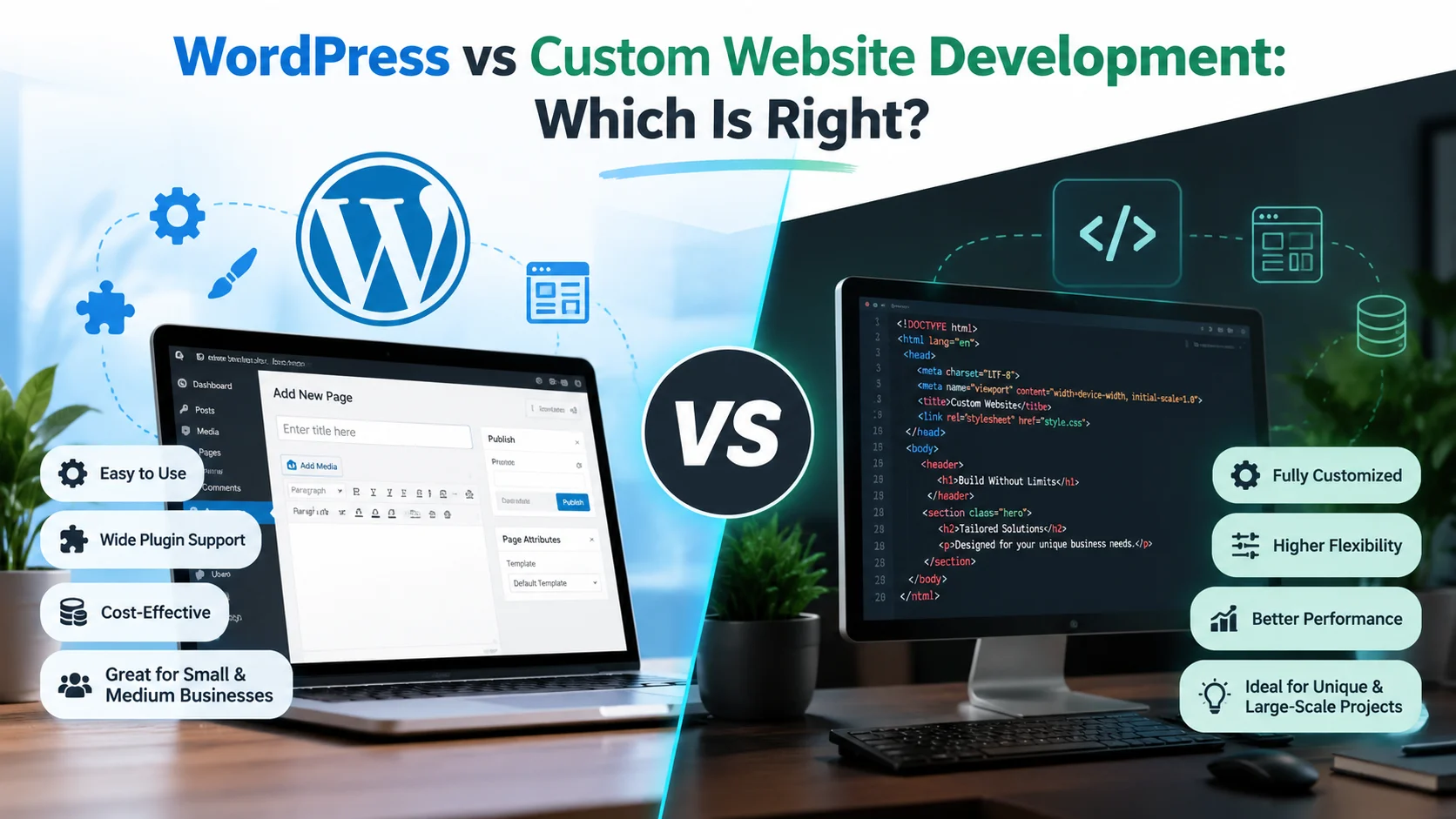
Choosing the right technology for your business website is an important decision. A website is not just an online presence—it can help businesses attract customers, generate leads, showcase services, and build trust.
When planning a new website, two popular options are WordPress website development and custom website development. Both options have their own advantages, and the right choice depends on your business goals, budget, features, and future requirements.
In this guide, we will compare WordPress vs custom website development to help you understand which solution may be the right fit for your business.
What Is WordPress Website Development?
WordPress is a popular content management system (CMS) that allows businesses to create and manage websites without building every feature from scratch.
With WordPress, developers can use themes, plugins, and custom development to create websites for different types of businesses.
WordPress can be used to build:
- Business websites
- Company websites
- Blogs and news websites
- Portfolio websites
- E-commerce stores
- Service-based websites
- Membership websites
One of the biggest advantages of WordPress is its flexibility. Developers can customize themes and plugins according to a business’s requirements.
What Is Custom Website Development?
Custom website development means creating a website specifically according to the requirements of a business.
Instead of relying mainly on pre-built themes and plugins, developers build the website’s design, functionality, and features based on the project’s specific needs.
Custom development can be suitable for businesses that need:
- Unique website designs
- Advanced functionality
- Custom integrations
- Complex business processes
- Highly specific user experiences
- Greater control over website architecture
Because the website is built specifically for the business, custom development can provide greater flexibility for specialized requirements.
WordPress vs Custom Website Development: Key Differences
Let’s compare WordPress and custom website development based on some important factors.
| Feature | WordPress | Custom Website |
|---|---|---|
| Development Time | Usually faster | Usually takes longer |
| Initial Cost | Generally lower | Generally higher |
| Customization | High | Very high |
| Maintenance | Relatively easy | Requires developer support |
| Plugins | Large plugin ecosystem | Features are developed specifically |
| Scalability | Suitable for many businesses | Highly customizable |
| Content Management | Easy | Depends on the system developed |
| Best For | Small to medium businesses and many growing businesses | Businesses with specialized requirements |
1. Development Cost
Budget is one of the first things businesses consider when choosing a website development approach.
A WordPress website can often be developed with a lower initial investment because businesses can use existing themes and plugins. However, additional customization and premium tools may increase the overall cost.
Custom website development generally requires more development time and resources. As a result, the initial investment can be higher.
Best choice: WordPress is usually more suitable for businesses looking for a cost-effective solution, while custom development can be a better investment for businesses with specialized requirements.
2. Development Time
WordPress websites can often be launched faster because developers can start with an existing theme or framework and customize it according to the project’s needs.
Custom websites usually require more time because the design, functionality, and architecture may need to be developed from the ground up.
If your business needs to launch a website quickly, WordPress can be a practical option.
3. Customization and Flexibility
Both WordPress and custom websites can be customized, but the level and approach of customization are different.
WordPress provides thousands of themes and plugins that can extend website functionality. Developers can also create custom themes, plugins, and features when required.
A custom website provides more control over the website’s structure and functionality because the system is developed specifically for the business.
For businesses with highly specific requirements, custom website development may provide greater flexibility.
4. Website Maintenance
Every website requires regular maintenance to remain secure, functional, and updated.
WordPress maintenance usually includes:
- Updating WordPress
- Updating themes and plugins
- Taking regular backups
- Monitoring website security
- Checking website performance
- Fixing compatibility issues
Custom websites also require maintenance, but the process depends on the technologies and architecture used to build the website.
For businesses without an in-house technical team, WordPress can be easier to manage when it is properly developed and maintained.
5. SEO Capabilities
Search engine optimization is important for businesses that want to attract organic traffic.
WordPress provides many SEO-friendly tools and plugins that can help businesses manage:
- Meta titles and descriptions
- XML sitemaps
- SEO-friendly URLs
- Image optimization
- Content optimization
- Structured data
However, having a WordPress website does not automatically guarantee higher search rankings. Technical SEO, quality content, website performance, backlinks, and user experience are also important.
Custom websites can also be highly SEO-friendly when developers follow proper technical SEO practices during development.
6. Security
Website security should be a priority regardless of the development platform.
WordPress websites need regular updates for the core software, themes, and plugins. Using trusted plugins, secure hosting, strong passwords, backups, and security monitoring can help reduce security risks.
With a custom website, developers have more control over the code and architecture. However, custom development does not automatically make a website completely secure.
Security depends on proper development practices, hosting, updates, authentication, monitoring, and maintenance.
7. Scalability
A growing business may need new features as its requirements change.
WordPress can scale effectively for many business websites, blogs, and e-commerce stores. New functionality can often be added using plugins or custom development.
Custom websites can also be highly scalable because the architecture can be designed around the business’s expected requirements.
For businesses with complex or rapidly evolving systems, custom development may offer more control over long-term scalability.
8. Content Management
One of WordPress’s biggest advantages is its easy-to-use content management system.
Business owners and content teams can create and update:
- Blog posts
- Pages
- Images
- Products
- Categories
- Website content
without needing to modify the website’s code.
With a custom website, the content management experience depends on the CMS or admin panel developed for the project.
If your team regularly publishes content, WordPress can be a convenient choice.
WordPress or Custom Website: Which One Should You Choose?
The right choice depends on your business requirements.
Choose WordPress if:
- You need a website within a reasonable budget.
- You want to launch your website quickly.
- You need an easy-to-manage CMS.
- Your website requires standard business features.
- You plan to publish blogs and content regularly.
- You need an e-commerce website with WooCommerce.
- You want access to a large ecosystem of plugins and integrations.
Choose Custom Website Development if:
- You need highly specialized functionality.
- Your business requires custom workflows.
- You need unique integrations with other systems.
- Your website requires a completely customized user experience.
- You have complex technical requirements.
- You need greater control over the website architecture.
Can WordPress Be Customized?
Yes. WordPress is not limited to pre-built themes and plugins.
Experienced developers can customize WordPress websites by creating or modifying:
- Custom themes
- Child themes
- Custom plugins
- Templates
- APIs and integrations
- WooCommerce functionality
- Custom post types
- Website layouts
- Admin features
This makes WordPress a flexible option for businesses that want a balance between affordability and customization.
Final Thoughts
There is no single answer to the WordPress vs custom website development debate. The right solution depends on your business goals, budget, timeline, technical requirements, and future plans.
WordPress can be an excellent choice for businesses looking for a flexible, cost-effective, and easy-to-manage website. On the other hand, custom website development can be a better option for businesses that require specialized functionality and complete control over their website.
Before choosing a development approach, consider your current requirements as well as your long-term business goals.
If you are unsure which option is right for your business, a professional web development team can help you evaluate your requirements and choose the most suitable solution.
Frequently Asked Questions
1. Is WordPress better than custom website development?
It depends on the business requirements. WordPress is suitable for many businesses because it is flexible, cost-effective, and easy to manage. Custom development may be better for businesses with complex or highly specialized requirements.
2. Is WordPress suitable for business websites?
Yes. WordPress can be used to create professional business websites, blogs, portfolios, service websites, and e-commerce stores.
3. Is custom website development more expensive than WordPress?
Custom website development can have a higher initial cost because the website’s functionality and architecture are developed specifically for the business.
4. Which is faster to develop: WordPress or a custom website?
WordPress websites can generally be developed faster, especially when using an existing theme and established plugins. Custom websites usually require more development time.
5. Can WordPress handle e-commerce websites?
Yes. WordPress can be used with WooCommerce to create and manage e-commerce websites, including products, orders, payments, and customer management.
6. Which option is better for SEO?
Both WordPress and custom websites can be optimized for SEO. Website structure, content quality, technical SEO, performance, mobile usability, and other factors are more important than the platform alone.
Build the Right Website for Your Business
Whether you need a WordPress website or a custom web development solution, choosing the right technology can help create a strong foundation for your online presence.