
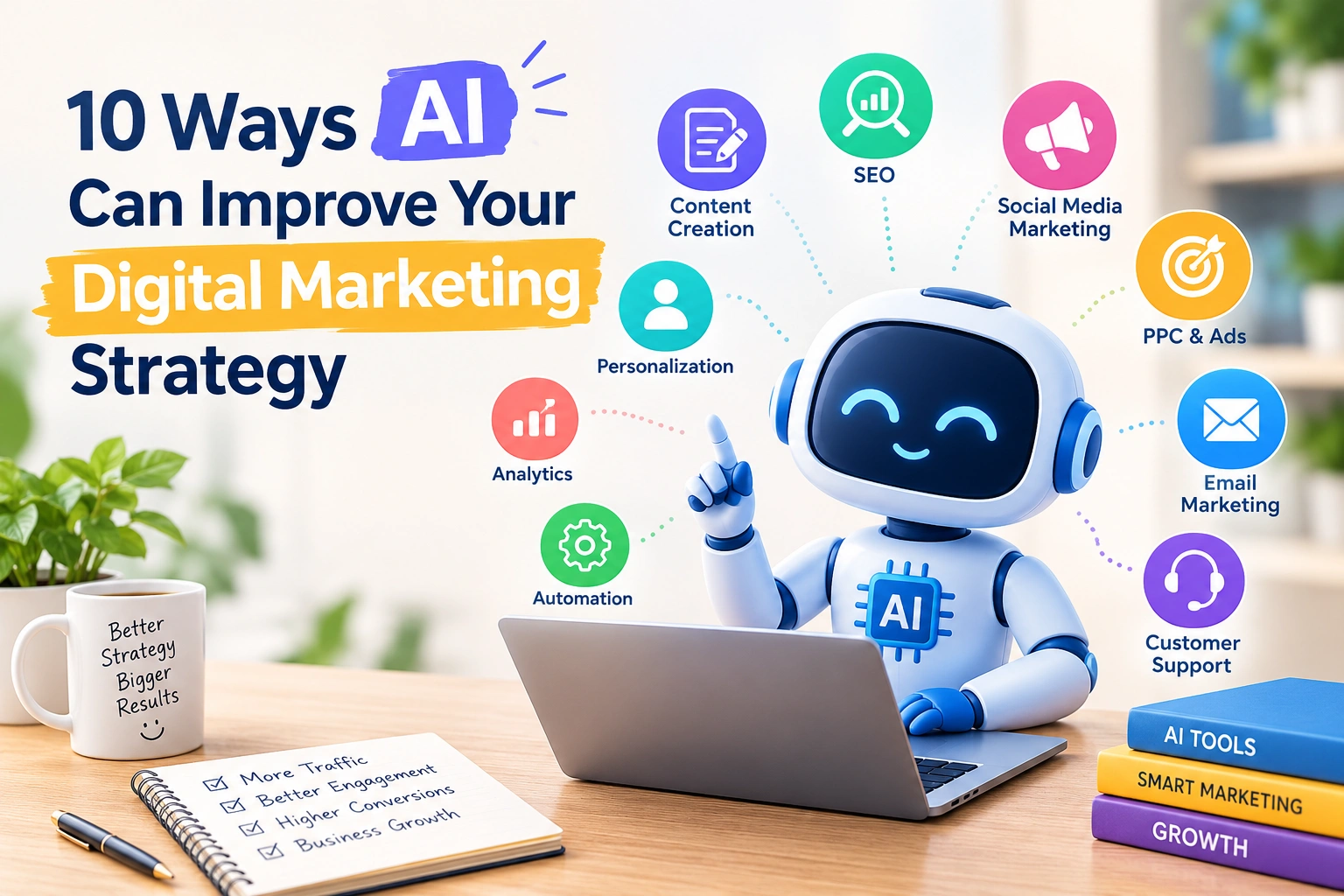
Digital marketing is changing quickly, and Artificial Intelligence (AI) is becoming an important part of that change. From creating content and understanding customers to analyzing campaign performance, AI can help marketers save time and make better decisions.
But AI is not here to replace digital marketers. Instead, it can work as a powerful tool that helps marketers handle repetitive tasks, understand data, and focus more on strategy and creativity.
Whether you run a small business, manage an e-commerce website, or work in marketing, using AI in the right way can make your digital marketing efforts more efficient and effective.
In this blog, we’ll explore 10 practical ways AI can improve your digital marketing strategy.
What Is AI in Digital Marketing?
AI in digital marketing means using artificial intelligence technologies to analyze information, understand customer behavior, automate tasks, and support marketing decisions.
For example, marketers can use AI to:
- Generate content ideas
- Understand customer preferences
- Analyze marketing data
- Improve SEO strategies
- Personalize customer experiences
- Automate repetitive tasks
- Optimize advertising campaigns
The goal is not to let AI handle everything. The best results come when marketers combine AI-powered tools with human creativity, experience, and decision-making.
1. Create Better Content Ideas
Coming up with fresh content ideas regularly can be difficult. AI can help marketers discover topics based on customer questions, industry trends, and common search queries.
Instead of spending hours trying to decide what to write about, marketers can use AI to brainstorm:
- Blog topics
- Social media ideas
- Video topics
- Email campaigns
- FAQs
- Content themes
- Ad copy ideas
For example, if you run a digital marketing agency, AI can suggest topics such as SEO, PPC, social media marketing, content marketing, and emerging marketing trends.
However, the final content should include your own knowledge, examples, and insights. This makes it more useful and authentic.
2. Improve SEO and Keyword Research
SEO requires understanding what people are searching for and what information they actually need. AI can help marketers analyze search-related information and identify useful keyword and topic opportunities.
AI can help with:
- Finding related keywords
- Understanding search intent
- Identifying content gaps
- Generating topic clusters
- Creating content outlines
- Improving existing content
- Finding related questions users may ask
For example, instead of targeting only the keyword “digital marketing,” you can explore related searches such as:
- Digital marketing strategies
- Digital marketing for small businesses
- Digital marketing trends
- AI in digital marketing
- Digital marketing tools
This helps create more comprehensive content around a topic rather than focusing on keyword repetition.
3. Personalize Customer Experiences
Customers are more likely to engage with content that feels relevant to them.
AI can analyze customer behavior and help businesses provide more personalized experiences.
For example, an e-commerce website can use customer activity to recommend products based on:
- Previous purchases
- Browsing history
- Products viewed
- Customer interests
- Shopping behavior
Personalization can also be used in email marketing, website content, product recommendations, and advertising.
Instead of showing the same message to every visitor, businesses can create experiences that are more relevant to different customer groups.
4. Improve Social Media Marketing
Managing multiple social media platforms can take a lot of time. AI can help marketers plan, create, and analyze social media content more efficiently.
AI can assist with:
- Post ideas
- Captions
- Content calendars
- Hashtag suggestions
- Audience analysis
- Engagement analysis
- Social media trends
For example, a marketer can use AI to create several caption ideas for a product launch and then edit the best one according to the brand’s tone.
The important part is to keep the brand’s personality consistent. AI-generated content should be reviewed before publishing.
5. Optimize PPC and Online Advertising
Paid advertising requires continuous monitoring and optimization. AI can help marketers analyze campaign data and identify patterns that may not be obvious at first glance.
AI can support tasks such as:
- Ad copy variations
- Audience segmentation
- Campaign analysis
- Performance monitoring
- Budget optimization
- Identifying high-performing keywords
- Testing different messages
For example, if one ad receives more clicks and conversions than another, AI can help identify patterns in the data and provide insights for future campaigns.
Still, marketers should make the final decisions based on business goals, budget, and campaign performance.
6. Automate Repetitive Marketing Tasks
One of the biggest advantages of AI is automation.
Digital marketers often spend time on repetitive activities that don’t necessarily require complex decision-making.
AI-powered tools can help automate tasks such as:
- Email responses
- Lead qualification
- Report generation
- Customer support
- Content scheduling
- Data organization
- Basic customer queries
Automation gives marketers more time to focus on important activities such as strategy, creative planning, and customer relationships.
7. Understand Customer Behavior
Understanding customers is one of the most important parts of digital marketing.
AI can analyze large amounts of customer data and identify patterns in how people interact with a business.
For example, AI can help marketers understand:
- Which pages customers visit
- What products they are interested in
- Where users leave a website
- Which marketing channels generate leads
- What type of content receives more engagement
These insights can help businesses make more informed marketing decisions.
Instead of relying only on assumptions, marketers can use data to understand what is actually working.
8. Improve Email Marketing
Email marketing becomes more effective when messages are relevant and delivered at the right time.
AI can help marketers improve email campaigns by analyzing customer behavior and engagement.
It can assist with:
- Subject line ideas
- Email content
- Audience segmentation
- Personalized recommendations
- Campaign analysis
- Send-time optimization
- Follow-up emails
For example, an online store can send different emails to a customer who has purchased a product and someone who has only viewed that product.
This makes communication more relevant and can improve customer engagement.
9. Analyze Marketing Performance
Digital marketing generates a lot of data, and understanding that data can sometimes be challenging.
AI can help marketers analyze campaign results and identify useful patterns.
Marketing teams can use AI to understand:
- Website traffic
- Conversion rates
- Customer engagement
- Ad performance
- Lead generation
- Content performance
- Campaign trends
For example, if website traffic is increasing but conversions are not, AI-assisted analysis can help marketers investigate possible reasons and identify areas that may need improvement.
The key is to use AI insights as a starting point and combine them with human analysis.
10. Improve Customer Support with AI
Customers often expect quick answers to simple questions. AI-powered chatbots can help businesses respond to common queries without requiring a team member to answer every message manually.
AI chatbots can assist customers with questions related to:
- Products and services
- Pricing
- Order information
- Business hours
- Basic troubleshooting
- Frequently asked questions
This can improve response times and provide support outside normal business hours.
However, complex or sensitive issues should still be handled by a human team member.
Benefits of Using AI in Digital Marketing
When used properly, AI can provide several benefits to marketing teams.
Some key benefits include:
- Saves time: Automates repetitive marketing activities.
- Better insights: Helps analyze large amounts of data.
- Improved personalization: Creates more relevant customer experiences.
- Faster content creation: Helps with ideas, outlines, and drafts.
- Better decision-making: Provides useful patterns and insights.
- Improved efficiency: Helps marketing teams manage more tasks.
However, AI should support your marketing strategy rather than become the strategy itself.
How to Use AI Effectively in Digital Marketing
Simply using AI tools does not guarantee better marketing results. Businesses should have a clear approach.
Here are some practical tips:
1. Start With a Clear Goal
Decide what you want AI to help with. It could be content creation, SEO, customer support, data analysis, or advertising.
2. Choose the Right Tools
Different AI tools are designed for different purposes. Choose tools based on your actual marketing requirements.
3. Review AI-Generated Content
Always check AI-generated content for accuracy, relevance, tone, and originality before publishing.
4. Add Human Creativity
Your experience, brand voice, and understanding of your customers are still extremely important.
5. Protect Customer Data
Businesses should be careful about the information they provide to AI tools and follow appropriate privacy and security practices.
6. Measure Results
Track important metrics and compare performance before and after implementing AI.
Common Mistakes to Avoid When Using AI for Marketing
AI can be useful, but using it without proper strategy can create problems.
Avoid:
- Publishing generic AI-generated content without editing
- Using AI for every marketing decision
- Ignoring your target audience
- Repeating keywords unnaturally
- Trusting AI-generated information without verification
- Losing your brand’s unique voice
- Focusing only on automation instead of customer needs
The best approach is to use AI for efficiency while keeping humans responsible for quality and important decisions.
Frequently Asked Questions (FAQs)
Is AI replacing digital marketers?
No. AI can automate certain tasks and provide useful insights, but human creativity, strategy, communication, and decision-making remain important in digital marketing.
How can AI help with SEO?
AI can help marketers understand search intent, discover related topics and keywords, create content outlines, analyze content, and identify opportunities for improving website visibility.
Can small businesses use AI for digital marketing?
Yes. Small businesses can use AI for content ideas, social media planning, customer support, email marketing, SEO research, and marketing analysis.
Is AI-generated content good for SEO?
AI-generated content can be useful when it provides accurate, helpful, original information. It should be reviewed and improved by humans rather than published as generic content without editing.
How does AI improve digital advertising?
AI can help analyze advertising data, identify patterns, test different messages, understand audiences, and support campaign optimization.
What is the biggest advantage of AI in digital marketing?
One of the biggest advantages is efficiency. AI can handle repetitive tasks and analyze large amounts of information, allowing marketers to spend more time on strategy and creative work.
Final Thoughts
AI is becoming an important part of modern digital marketing. From SEO and content creation to social media, advertising, customer support, and data analysis, AI can help businesses work more efficiently and understand their customers better.
However, successful digital marketing is not about using AI for everything. It is about finding the right balance between technology and human expertise.
Use AI to save time, discover insights, and improve your marketing processes—but continue to rely on human creativity, experience, and judgment to create meaningful connections with your audience.
As AI continues to evolve, businesses that learn how to use it responsibly and strategically can be better prepared for the future of digital marketing.