
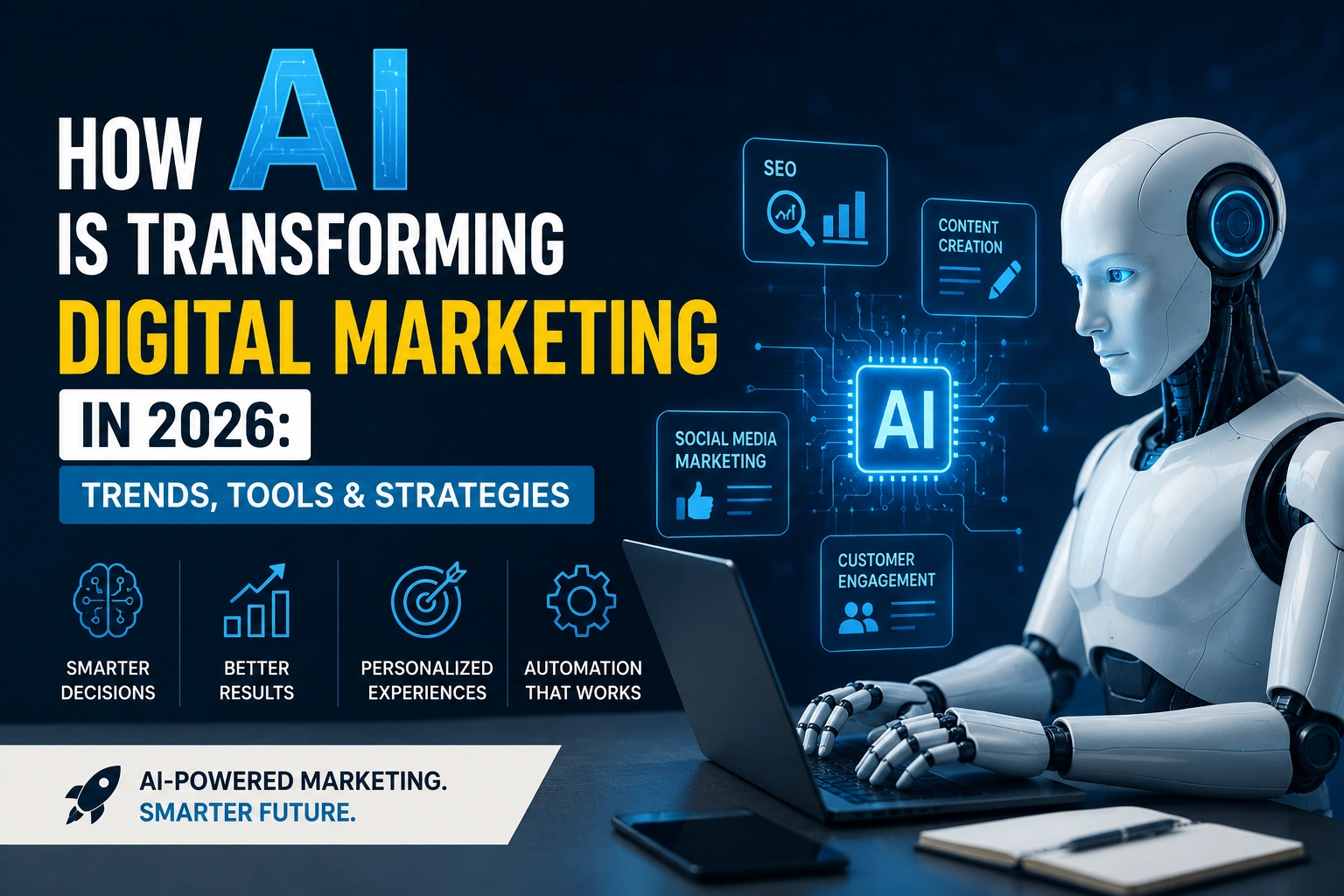
Artificial Intelligence (AI) is no longer a futuristic concept—it’s becoming an essential part of modern digital marketing. In 2026, businesses of all sizes are using AI to create better content, improve customer experiences, optimize campaigns, and make smarter marketing decisions.
Whether you’re a startup, an eCommerce brand, or a growing business, AI can help you save time, reduce costs, and increase your marketing performance.
In this article, we’ll explore how AI is transforming digital marketing, the latest trends, the best AI tools, and practical strategies your business can use today.
Why AI Matters in Digital Marketing
Traditional marketing often relies on manual research, repetitive tasks, and guesswork. AI changes this by analyzing large amounts of data in seconds and providing actionable insights.
Businesses can now:
- Create content faster
- Understand customer behavior
- Personalize marketing campaigns
- Improve search engine rankings
- Automate repetitive tasks
- Increase conversion rates
As customer expectations continue to rise, AI helps businesses deliver faster, smarter, and more personalized experiences.
Top AI Trends in Digital Marketing for 2026
1. AI-Powered Content Creation
Content remains one of the most important parts of digital marketing, and AI is making content production faster than ever.
Marketers use AI to:
- Generate blog ideas
- Write first drafts
- Create social media captions
- Generate email campaigns
- Produce product descriptions
- Rewrite and optimize existing content
While AI speeds up the process, human editing remains essential for accuracy, creativity, and brand voice.
2. Smarter SEO Optimization
Search Engine Optimization (SEO) has become more data-driven with AI.
AI tools help marketers:
- Discover high-value keywords
- Analyze competitors
- Improve on-page SEO
- Optimize headings and meta descriptions
- Identify content gaps
- Predict search trends
Businesses that combine AI insights with quality content often achieve better search visibility and higher organic traffic.
3. Personalized Customer Experiences
Customers expect personalized experiences across websites, emails, and social media.
AI analyzes customer behavior to recommend:
- Relevant products
- Personalized emails
- Dynamic website content
- Custom offers
- Product recommendations
Personalization improves customer satisfaction and increases sales.
4. AI for Social Media Marketing
Managing multiple social media platforms can be time-consuming.
AI helps marketers:
- Generate post ideas
- Create captions
- Suggest hashtags
- Schedule content
- Analyze engagement
- Recommend the best posting times
This allows businesses to maintain consistent social media activity while saving valuable time.
5. AI Chatbots for Customer Support
Modern AI chatbots can answer customer questions 24/7.
Benefits include:
- Faster response times
- Reduced support costs
- Better customer satisfaction
- Higher lead generation
- Improved user experience
AI chatbots can qualify leads before connecting customers with a sales representative.
6. AI-Powered Advertising
Advertising platforms are becoming increasingly AI-driven.
AI helps marketers:
- Optimize ad targeting
- Adjust bidding strategies
- Test multiple ad creatives
- Improve campaign performance
- Increase return on investment (ROI)
Instead of relying solely on manual optimization, marketers can make data-backed decisions.
Best AI Tools for Digital Marketing in 2026
Here are some of the most popular AI tools marketers use:
- ChatGPT – Content writing, brainstorming, customer support, and marketing ideas.
- Google Gemini – Research, content generation, and productivity.
- Claude – Long-form writing and document analysis.
- Canva AI – Social media graphics, presentations, and marketing creatives.
- Jasper AI – Marketing copy, blogs, and ad content.
- Surfer SEO – SEO optimization and content scoring.
- Notion AI – Content planning, documentation, and productivity.
- Grammarly AI – Writing improvement and grammar suggestions.
The right combination of tools depends on your business goals and marketing strategy.
Benefits of Using AI in Digital Marketing
Businesses adopting AI are experiencing several advantages:
- Faster content creation
- Better audience targeting
- Improved SEO performance
- Higher marketing efficiency
- Reduced operational costs
- Better customer engagement
- Increased conversion rates
- Data-driven decision-making
Rather than replacing marketers, AI helps them work more efficiently.
Challenges of AI in Marketing
Although AI offers many benefits, businesses should also be aware of its limitations.
Some common challenges include:
- AI-generated content requires human review.
- Privacy regulations continue to evolve.
- Over-reliance on automation can reduce brand authenticity.
- AI may produce inaccurate or outdated information.
- Ethical use of customer data remains important.
Successful businesses use AI as a support tool rather than a complete replacement for human expertise.
Future of AI in Digital Marketing
AI will continue to reshape the marketing industry over the next few years.
Future developments may include:
- Hyper-personalized customer experiences
- Advanced predictive analytics
- Smarter voice search optimization
- AI-generated video marketing
- Automated campaign management
- Improved customer journey mapping
Businesses that embrace AI early will be better positioned to remain competitive in an increasingly digital marketplace.
Final Thoughts
Artificial Intelligence is transforming digital marketing by making campaigns more efficient, data-driven, and personalized. From content creation and SEO to customer support and advertising, AI is helping businesses achieve better results while reducing manual effort.
However, the best marketing strategies combine AI with human creativity, strategic thinking, and genuine customer understanding.
If your business wants to stay competitive in 2026 and beyond, now is the perfect time to integrate AI into your digital marketing strategy.
Frequently Asked Questions (FAQs)
Is AI replacing digital marketers?
No. AI automates repetitive tasks, but human creativity, strategy, and decision-making remain essential.
Which AI tool is best for digital marketing?
There isn’t a single best tool. ChatGPT, Google Gemini, Canva AI, Jasper AI, Surfer SEO, and Claude are among the most popular options.
Can AI improve SEO?
Yes. AI can assist with keyword research, content optimization, competitor analysis, and technical SEO, but high-quality human-reviewed content is still crucial for long-term success.
Should small businesses use AI?
Absolutely. AI helps small businesses save time, automate marketing tasks, and compete more effectively with larger brands.