
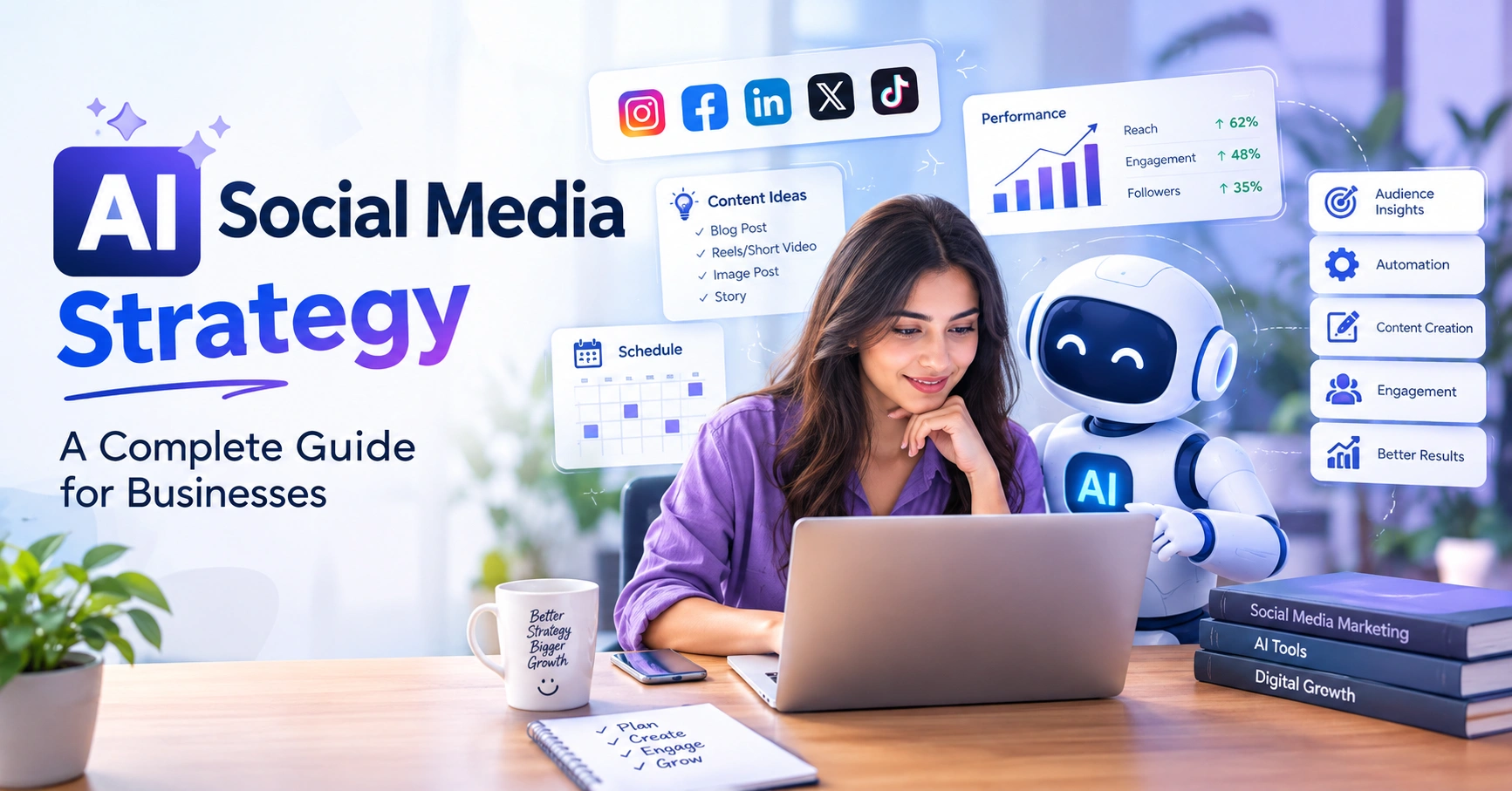
Social media has become an important part of how businesses connect with their customers. But managing multiple social media platforms can take a lot of time. From creating content and writing captions to understanding audience behavior and tracking results, there is a lot to handle.
This is where an AI Social Media Strategy can make a real difference.
Artificial intelligence can help businesses understand their audience, generate content ideas, analyze performance, and automate repetitive tasks. However, AI is not meant to replace the human side of social media. The best results come when businesses use AI to save time while keeping their own creativity, brand voice, and personality.
In this guide, we will look at what an AI Social Media Strategy is, how it works, its benefits, and practical ways businesses can use it.
What Is an AI Social Media Strategy?
An AI Social Media Strategy is a social media marketing approach that uses artificial intelligence to make planning, content creation, audience research, and performance analysis more efficient.
Instead of handling every task manually, marketers can use AI-powered tools to support different parts of their social media workflow.
For example, AI can help you:
- Generate content ideas
- Create social media captions
- Understand audience interests
- Find relevant topics and trends
- Repurpose existing content
- Analyze social media performance
- Suggest suitable posting times
- Personalize content for different audiences
- Automate repetitive marketing tasks
The goal is not to let AI run your entire social media presence. Instead, it should help your team work smarter and spend more time on strategy and creative decisions.
Why Should Businesses Use AI for Social Media?
Creating social media content consistently can be challenging, especially for small businesses with limited marketing teams.
AI can reduce some of this workload and help marketers organize their daily activities more efficiently.
1. Saves Time
Social media requires regular content. AI can help marketers quickly generate ideas, captions, content outlines, and variations for different platforms.
This can reduce the time spent on repetitive tasks.
2. Helps Generate Content Ideas
Sometimes the hardest part of social media marketing is simply deciding what to post.
AI can help brainstorm ideas based on your industry, audience, products, or services.
For example, a digital marketing company could use AI to generate ideas around:
- SEO tips
- Social media trends
- Website optimization
- Marketing mistakes
- Industry news
- Customer questions
The marketer can then select the useful ideas and add their own experience and perspective.
3. Understands Audience Behavior
AI-powered analytics can help businesses identify patterns in audience engagement.
You can learn which types of posts receive more interaction, what topics attract attention, and how people respond to different content formats.
These insights can help you improve future content.
4. Supports Personalization
Different customers may have different interests.
AI can help businesses organize audiences into relevant groups and create more personalized content or marketing messages.
For example, an online store might create different content for first-time visitors, returning customers, and customers interested in specific product categories.
5. Improves Content Planning
Instead of deciding what to post every morning, businesses can use AI to support a structured content calendar.
You can plan content around:
- Educational posts
- Product or service promotions
- Customer stories
- Behind-the-scenes content
- Industry updates
- FAQs
- Seasonal campaigns
This creates a more consistent social media presence.
How to Build an AI Social Media Strategy
Using AI effectively starts with a clear strategy. Simply generating random AI content every day will not necessarily improve your social media marketing.
Here is a simple process you can follow.
Step 1: Define Your Social Media Goals
First, decide what you want to achieve.
Your goal could be:
- Increasing brand awareness
- Generating leads
- Driving website traffic
- Increasing engagement
- Building a community
- Promoting products or services
- Improving customer communication
Your goals will determine what type of content you should create.
Step 2: Understand Your Target Audience
Before creating content, understand who you are trying to reach.
Think about:
- Age group
- Location
- Interests
- Problems
- Buying behavior
- Frequently asked questions
- Preferred social media platforms
AI can help organize and analyze audience data, but your marketing team should still make the final decisions based on real customer knowledge.
Step 3: Create a Content Strategy
Now decide what types of content you want to publish.
A simple content mix could include:
Educational content: Share useful tips and information.
Promotional content: Highlight your products, services, offers, or features.
Engagement content: Ask questions, create polls, or encourage discussions.
Social proof: Share reviews, testimonials, or customer experiences.
Behind-the-scenes content: Show the people and process behind your business.
Having different content types keeps your social media feed more useful and interesting.
Step 4: Use AI to Generate Ideas
Once you have your content categories, AI can help you brainstorm ideas.
For example, you could ask an AI tool:
“Give me 15 Instagram post ideas for a digital marketing company targeting small businesses.”
You can then select the most relevant ideas and adjust them according to your brand.
Remember, AI-generated ideas should be a starting point rather than the final content.
Step 5: Create and Customize Your Content
AI can help create captions, headlines, outlines, and variations.
However, don’t publish everything exactly as AI generates it.
Add:
- Your brand’s tone
- Real examples
- Original insights
- Customer experiences
- Industry-specific information
This makes your content feel more authentic and less generic.
Step 6: Schedule Your Content
Consistency is important on social media.
A content calendar can help you decide:
- What to post
- Which platform to use
- When to publish
- Who is responsible
- What the goal of each post is
AI and social media management tools can make planning and scheduling easier.
Step 7: Track Your Performance
After publishing content, look at the results.
Important metrics can include:
- Reach
- Impressions
- Engagement
- Likes and comments
- Shares
- Saves
- Click-through rate
- Website traffic
- Leads or conversions
AI-powered analytics can help identify patterns in this data and highlight areas that may need attention.
AI Social Media Strategy for Different Platforms
Your strategy should not be exactly the same on every platform.
AI can help with:
- Caption ideas
- Reel concepts
- Content themes
- Hashtag research
- Content calendars
Visual quality and authenticity are still important, so AI should support—not replace—creative work.
Businesses can use AI to support:
- Post creation
- Audience analysis
- Ad variations
- Customer communication
- Content planning
AI can help businesses create ideas for:
- Industry insights
- Thought leadership posts
- Company updates
- Educational content
- Professional tips
However, personal experience and genuine expertise are especially valuable on LinkedIn.
X
AI can help with:
- Short-form content ideas
- Trend monitoring
- Post variations
- Conversation topics
Businesses should always review AI-generated posts before publishing, particularly when discussing current events or sensitive topics.
Common Mistakes to Avoid
AI can make social media marketing easier, but it should not be used without human review.
Publishing AI Content Without Editing
AI-generated content can sometimes sound repetitive or generic. Always review and personalize it.
Ignoring Your Brand Voice
Your social media content should sound like your business—not like a generic AI tool.
Focusing Only on Quantity
Posting more content does not automatically mean better marketing.
Focus on creating useful and relevant content for your audience.
Not Checking AI-Generated Information
AI can make mistakes or provide outdated information. Verify important facts before publishing them.
Forgetting the Human Element
Social media is about people and conversations.
Respond to comments, listen to customers, share real experiences, and encourage genuine conversations.
Benefits of an AI Social Media Strategy
When used properly, AI can support businesses in several ways:
- Faster content planning
- More content ideas
- Better audience insights
- More efficient workflows
- Easier content personalization
- Improved performance analysis
- Reduced repetitive work
- More consistent posting
The biggest benefit is not simply creating content faster. It is giving marketers more time to focus on creativity, strategy, and building relationships with their audience.
The Future of AI in Social Media Marketing
AI is becoming an increasingly useful part of digital marketing. As AI tools continue to develop, businesses may have more opportunities to understand customers, personalize communication, analyze campaigns, and automate repetitive tasks.
But technology alone cannot create a strong brand.
Businesses still need creativity, human judgment, originality, and a clear understanding of their customers.
The most effective approach is likely to combine AI’s ability to process information and automate tasks with the human ability to understand emotions, context, and relationships.
Final Thoughts
An AI Social Media Strategy can help businesses make social media marketing more organized, efficient, and data-driven.
From generating content ideas to analyzing performance, AI can support marketers throughout the social media process. But it should be treated as a helpful assistant rather than a complete replacement for human creativity.
Start with one or two areas where your team spends the most time, such as content ideation or performance analysis. Test how AI can help, review the results, and gradually build it into your workflow.
The key is simple: use AI to work smarter, while keeping your brand human.
Frequently Asked Questions
What is an AI Social Media Strategy?
An AI Social Media Strategy uses artificial intelligence to support social media activities such as content planning, audience analysis, content creation, personalization, and performance tracking.
How can AI help with social media marketing?
AI can help generate content ideas, write draft captions, analyze audience behavior, identify patterns in performance data, and automate some repetitive marketing tasks.
Can AI completely manage social media?
AI can automate and support many tasks, but human involvement is still important. Businesses need people to review content, maintain brand voice, make strategic decisions, and communicate authentically with customers.
Is AI useful for small businesses?
Yes. Small businesses can use AI to save time on repetitive marketing tasks and support content planning, research, and analysis without needing a large marketing team.
What is the biggest advantage of AI in social media?
One major advantage is efficiency. AI can reduce the time spent on repetitive tasks, allowing marketers to focus more on creative work, strategy, and customer relationships.