
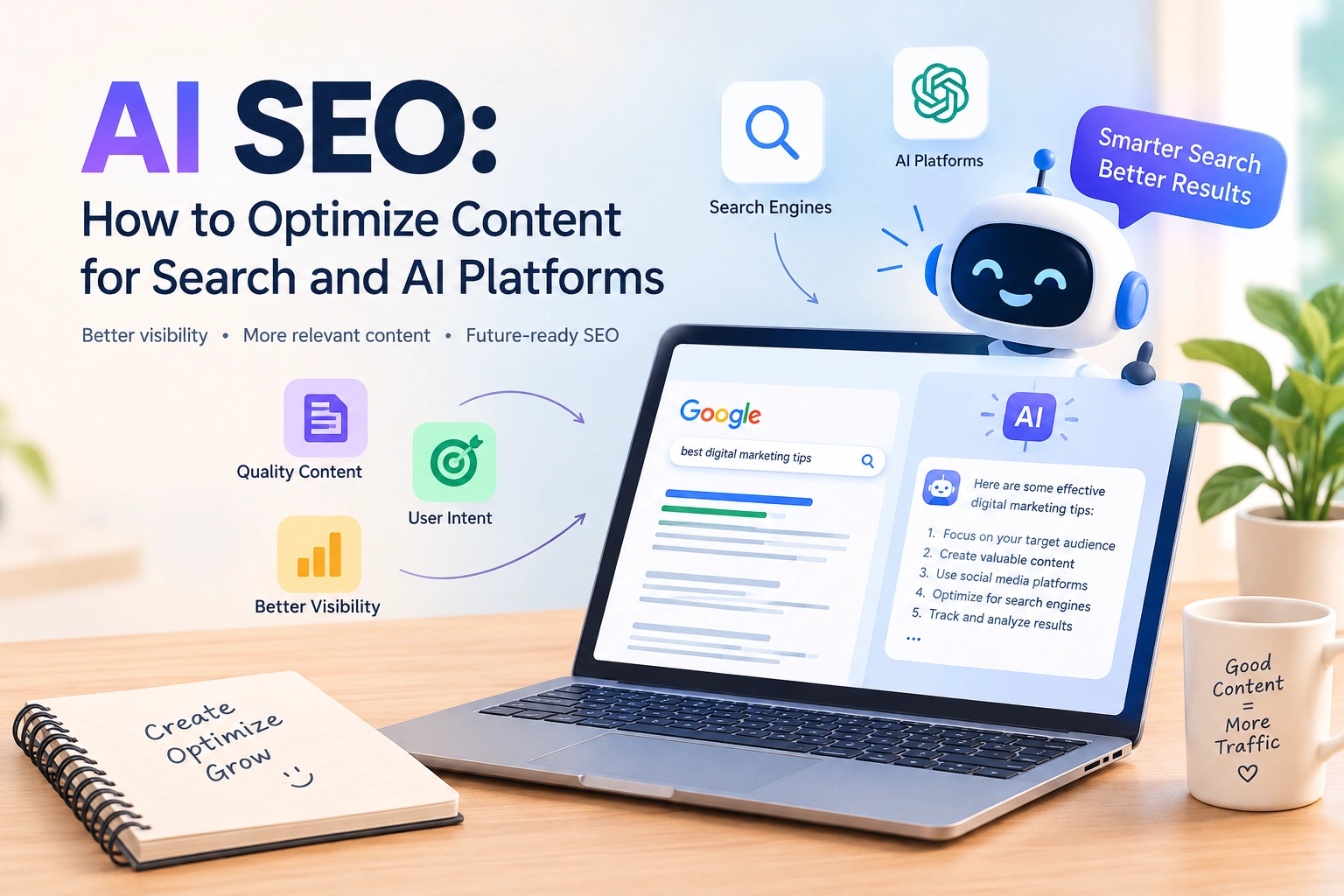
Search is changing rapidly. People are no longer relying only on traditional search engines to find information. Today, users are also asking AI-powered platforms for recommendations, answers, product comparisons, and solutions.
This shift has introduced a new concept known as AI SEO. It combines traditional search engine optimization with strategies that help content become more useful, understandable, and discoverable by AI-powered search platforms.
For businesses and marketers, adapting to AI SEO is becoming increasingly important. So, how can you create content that performs well in both traditional search and AI-powered platforms? Let’s explore.
What Is AI SEO?
AI SEO is the process of optimizing online content so that it can be easily understood and discovered by both search engines and AI-powered platforms.
Traditional SEO focuses heavily on ranking pages in search engine results. AI SEO takes this further by creating content that provides clear, accurate, relevant, and trustworthy information that AI systems can understand and potentially use when generating answers.
The goal is not simply to add more keywords. Instead, it is about creating genuinely useful content that clearly answers users’ questions.
Why Is AI SEO Important?
Search behavior is evolving. Instead of searching with short keywords such as “best digital marketing agency,” users may ask detailed questions like:
“What should a small business look for when choosing a digital marketing agency?”
AI-powered platforms can understand the context behind these questions and provide detailed answers.
This means businesses need to focus on topics, context, user intent, and quality rather than relying only on keyword repetition.
A strong AI SEO strategy can help businesses:
- Improve visibility in search results
- Provide better answers to customer questions
- Build authority in their industry
- Reach users through AI-powered search experiences
- Improve the overall quality of website content
AI SEO vs Traditional SEO
Traditional SEO and AI SEO are closely connected, but there are some differences.
Traditional SEO generally focuses on factors such as keywords, backlinks, technical SEO, website structure, and search rankings.
AI SEO places additional emphasis on:
- Clear and direct answers
- Strong topical coverage
- Natural language
- Context and relevance
- Reliable and trustworthy information
- Structured content
- Demonstrated expertise
This does not mean traditional SEO is no longer important. Instead, AI SEO should be viewed as an extension of a strong SEO strategy.
1. Understand Search Intent
One of the most important steps in AI SEO is understanding search intent.
Before creating content, ask:
- What is the user trying to find?
- What problem are they trying to solve?
- What questions might they have?
- What information would help them make a decision?
For example, someone searching for “AI SEO tools” may want a list of tools, while someone asking “How can AI improve SEO?” may want an explanation and practical strategies.
Creating content based on the user’s actual intent makes it more useful for both people and search technologies.
2. Create Helpful and Original Content
AI SEO is not about producing large amounts of automatically generated content.
Your content should provide real value.
Instead of rewriting information that already exists online, try to add:
- Original insights
- Examples
- Case studies
- Expert opinions
- Practical tips
- Data and research
- Step-by-step instructions
For example, instead of simply explaining what AI SEO is, you could show how a business can apply AI SEO to its website and measure the results.
3. Answer Questions Clearly
AI platforms often need to understand specific questions and their answers.
Make your content easy to scan by using clear headings and question-based sections.
For example:
What is AI SEO?
Give a short and direct answer first, followed by additional explanation.
You can also include sections such as:
- What are the benefits of AI SEO?
- How does AI SEO work?
- How can businesses optimize content for AI search?
- What are common AI SEO mistakes?
This structure makes content easier for users to navigate and easier for systems to understand.
4. Use Natural and Conversational Language
People don’t always search using perfect keywords.
They may ask complete questions or use conversational phrases.
Instead of forcing the same keyword repeatedly into your content, write naturally.
For example, rather than repeatedly using:
“AI SEO services”
you can naturally discuss related concepts such as:
- AI-powered SEO
- search optimization
- AI search platforms
- content optimization
- search visibility
- SEO strategy
This creates richer, more natural content while still covering the topic comprehensively.
5. Build Topical Authority
Creating one article about a topic may not be enough to establish strong expertise.
Consider building a collection of related content around your main subject.
For example, if your website focuses on digital marketing, you could create articles about:
- AI SEO
- AI content marketing
- AI social media marketing
- AI-powered advertising
- Generative AI for businesses
- AI marketing tools
- The future of search
These related articles can help demonstrate that your website has meaningful coverage of the broader topic.
6. Use Structured Content
Good content structure is important for both users and search technologies.
Use:
- H1 for the main page title
- H2 for major sections
- H3 for subsections
- Short paragraphs
- Bullet points
- Numbered lists
- Tables where appropriate
- Descriptive headings
For example, instead of writing one long section about AI SEO strategies, break it into individual sections such as Keyword Research, Content Quality, Technical SEO, and User Intent.
7. Strengthen E-E-A-T Signals
Trust is becoming increasingly important in search.
Google’s E-E-A-T framework refers to:
- Experience
- Expertise
- Authoritativeness
- Trustworthiness
Businesses can strengthen these signals by providing information about authors, demonstrating relevant experience, citing credible sources, keeping content updated, and providing accurate information.
For topics involving important decisions, credibility becomes even more important.
8. Don’t Ignore Technical SEO
AI SEO does not replace technical SEO.
Your website still needs a strong technical foundation.
Pay attention to:
- Mobile responsiveness
- Page speed
- Crawlability
- Internal linking
- HTTPS
- XML sitemaps
- Proper heading structure
- Clean URLs
- Structured data where appropriate
If search engines and other systems cannot properly access or understand your website, great content may not reach its full potential.
9. Use AI as a Tool, Not a Replacement
AI can make content creation and SEO workflows faster, but it should not replace human judgment.
Marketers can use AI to:
- Generate content ideas
- Research topics
- Create outlines
- Identify related questions
- Analyze content
- Improve readability
- Generate initial drafts
However, every piece of AI-assisted content should be reviewed and improved by a human.
Add your own experience, examples, insights, and fact-checking to make the content more valuable and trustworthy.
10. Keep Your Content Updated
AI SEO is not a one-time activity.
Search trends, user behavior, technologies, and industry information continue to change.
Review important content regularly and update:
- Statistics
- Examples
- Links
- Product information
- Industry trends
- Outdated recommendations
Keeping content fresh can improve its usefulness and help maintain its relevance over time.
Common AI SEO Mistakes to Avoid
While optimizing content for AI-powered search, avoid these common mistakes:
Keyword Stuffing
Repeating keywords excessively can make content difficult to read. Focus on natural language and user intent instead.
Publishing Low-Quality AI Content
Using AI to produce large amounts of generic content without human review can reduce quality and trust.
Ignoring the Audience
SEO should ultimately serve people. Don’t create content only for algorithms.
Using Unverified Information
Always verify facts, statistics, and claims before publishing them.
Forgetting Traditional SEO
AI SEO does not mean abandoning technical SEO, links, website performance, or other established SEO fundamentals.
How to Create an AI SEO-Friendly Content Strategy
A practical approach can look like this:
Step 1: Choose a relevant topic.
Step 2: Research what your audience wants to know.
Step 3: Identify the main search intent.
Step 4: Find related questions and subtopics.
Step 5: Create a clear content structure.
Step 6: Write useful, original, and easy-to-understand content.
Step 7: Add examples, data, and expert insights.
Step 8: Optimize the technical aspects of the page.
Step 9: Review and fact-check the content.
Step 10: Monitor performance and update the content regularly.
The Future of AI SEO
The future of search is likely to become increasingly conversational and personalized.
As AI-powered search experiences continue to develop, users may spend less time browsing multiple pages and more time interacting directly with AI-generated answers.
For businesses, this means creating content that is clear, useful, authoritative, and genuinely valuable will become even more important.
SEO is no longer only about getting a page to rank for a particular keyword. It is increasingly about becoming a reliable source of information for users wherever they search.
Conclusion
AI SEO is changing how businesses approach content and search visibility. While traditional SEO fundamentals remain important, businesses should also focus on creating content that clearly answers questions, demonstrates expertise, satisfies search intent, and provides genuine value.